Got these beautiful words by Natasha Badhwar in my email today. Reminds me so much of Nisarga’s enterprising ways.
Raise a child who laughs in the face of fear. A child who respects his parents and protects his family even when he disagrees with them…
Raise a child who is not afraid of his own voice. Who does not hide to stay safe, especially when his silence can be used to target and hurt others.
Raise a child you are willing to learn from. A child you might have to hold protest rallies to protect one day. A child you will defend. A child you might have to hold candles to commemorate one day.
Be a fearless parent.
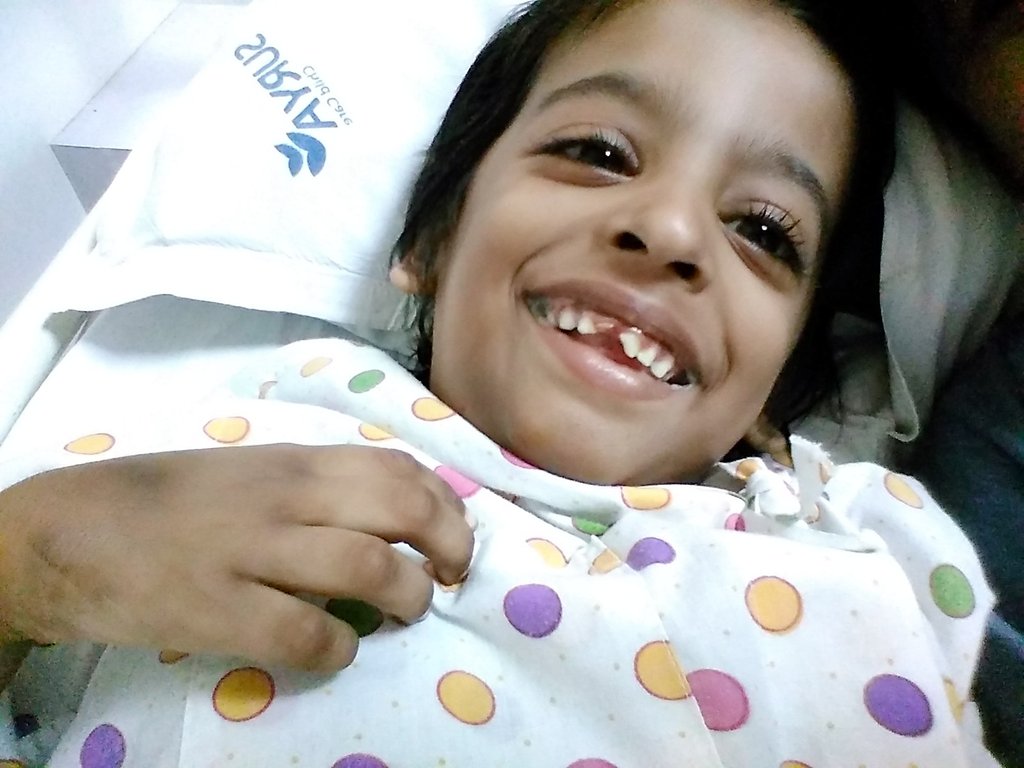
I am happy to report that one week after the surgery, Nisarga’s pain is minimal. He is still a little subdued (mostly because he can’t do much with half his body in a cast), but there is little pain, lots of smiles, and we even had a moment when he balanced himself well enough to raise both hands – something not really possible for him, because he used to need to keep both hands on floor to sit even briefly. I’m hoping this means that even with the support of the plaster cast, part of it is also that his hip is in position where it should be, allowing his weight to rest on it, instead of needing to use his hands.
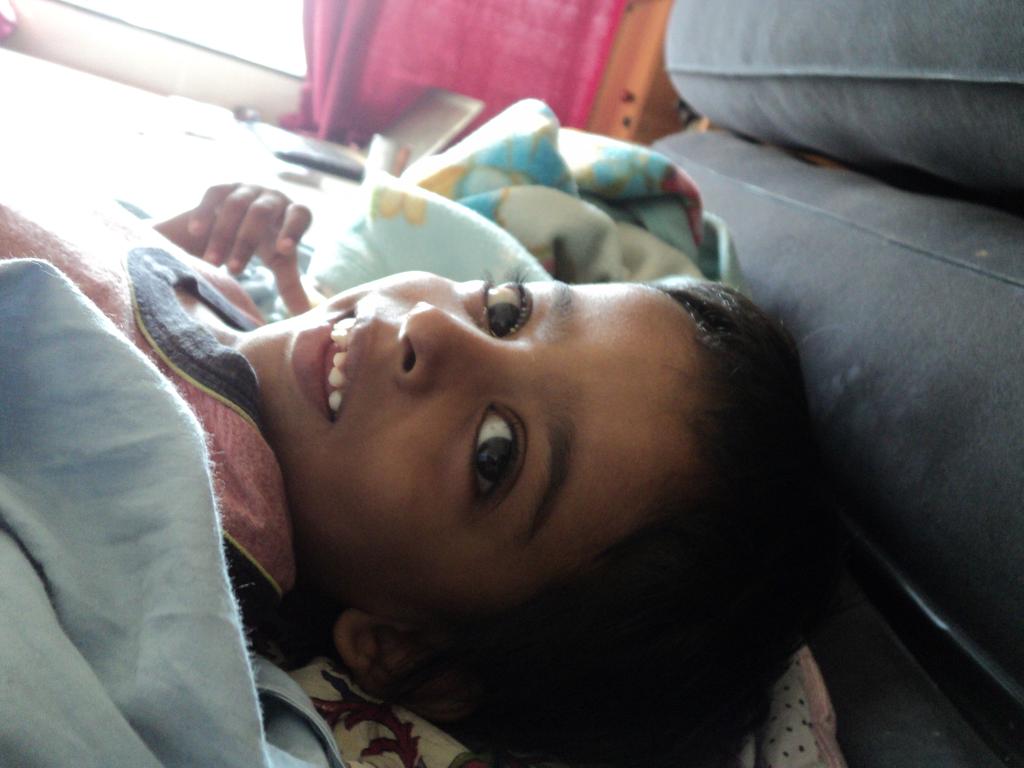
It isn’t all easy. Movement for him is very difficult, and being comfortable can also be a pain when his body can’t really change position. It can result in some strange contortions like…
Nisarga sleeping in his spica cast
He is just not used to sleeping on his back, so invariably he wants to sleep on his stomach. But the first few days, he wasn’t comfortable on his stomach. When he fell asleep in the middle of changing his diaper (I had turned him like that to tuck the backside of the diaper into the cast), we decided to prop him into place if the position gave him enough comfort to fall asleep instantly.
The pain is better now. Will his movements also be?
Who knows? Only time will tell.
In the meanwhile, Nisarga has gone from trying to cut and rearrange my handmade soaps to trying to put the in plastic bags and shrink wrap them, because monkey see, monkey do, and mom isn’t cutting soap these days and we are each other’s best fans and pals. Like so.
Nisarga’s hip has been found to be dislocated. A few weeks ago, my husband and his mother took him to another doctor who described physiotherapy. Whoever’s followed his story for long knows he doesn’t deal well with physiotherapy and I was reluctant to send him. But there really seemed no other options to help him move either, as he had reached a plateau of sorts with the Feldenkrais Method as well.
So, I was on the net as usual, trying to find out what his problem was and how I could help him move. I had suspected a problem with his hips several times and even mentioned it to doctors who dismissed it as his spasticity. But to me it genuinely seemed like he is not able to use his hips properly even with muscles relaxed.
I found a photo of a hip dislocation and it was like a bulb lit in my head. That is exactly how Nisarga’s leg presents! This was late Tuesday night. I spent all night consuming videos of hip dislocations. They all showed adults, but their legs presented exactly like Nisarga’s. On Wednesday, I went to a local doctor and demanded that he write us a prescription for an X-Ray. He wrote it for a spinal X-Ray, which would cover whole spine including hips. We went and got it done. On returning home, I checked the X-Ray which was mostly normal other than some problems with his 5th Lumbar vertebra. That didn’t seem right. I was pretty certain his hip was dislocated. So I tried to see what his hip looked like on the X-Ray, and it wasn’t included.
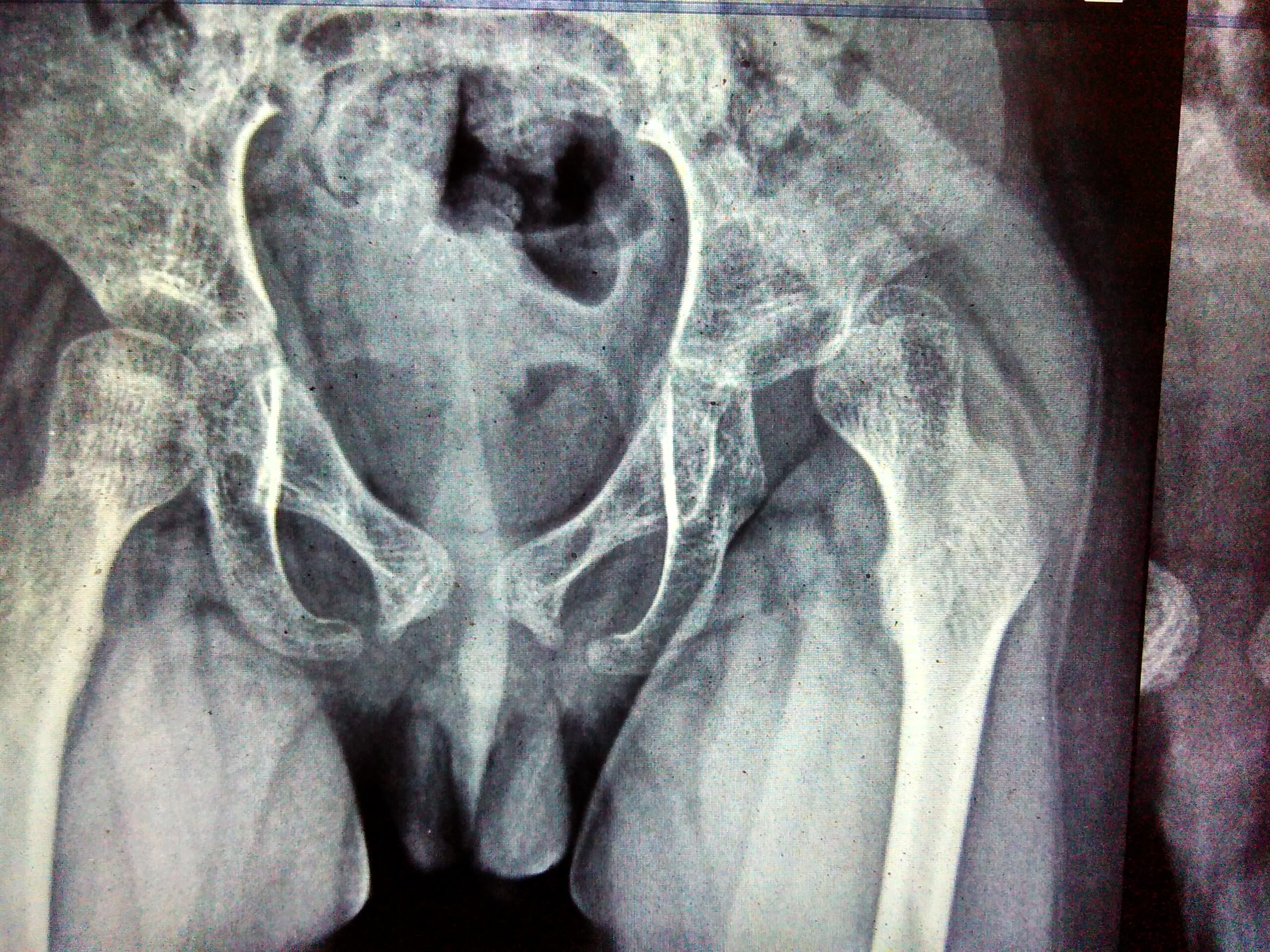
So we went again, the next day to get another X-Ray done. Of the pelvis this time. And there it was. A clearly dislocated hip, on the technician’s monitor itself. Right there – first glance.
That put us on a round of doctors and tests and the long story made short is we are admitting him to Surya Hospital tomorrow and he will undergo a four to five hour surgery on Thursday morning to fix his hip. The doctor said he will try a closed reduction first (manipulating the joint back into place under general anesthesia, but without surgery). If that doesn’t work, he will do an open reduction (surgery to bring joint into correct position). If that succeeds, well and good. But there may be abnormal growth of the thigh bone preventing it, in which case he will need a femoral osteotomy as well and a pelvic osteotomy if the socket in the pelvis where the ball of the joint on the femur should fit is not shaped correctly to receive it. So a minimum of one and maximum of three procedures will be done on him on Thursday.
After the surgery, he will be placed in a spica cast which will immobilize his hips and legs in the correct position (rather like riding a horse) to hold the joint stable so that it heals in the correct position.
That is what is going on. It is scary thinking of him undergoing surgery (I don’t really trust doctors after our experiences with him, plus he is so small), but I am convinced his hip needs to return to correct position so that he can use it to balance himself and sit at least, if not walk. It will hopefully prevent long term pain and deterioration of his hip. So while scary, I am convinced it is necessary and a part of me is relieved that we found out what the problem was so that it can be fixed.
That is where we are. Nisarga is completely normal at this point. He doesn’t know a better hip, so all is routine with him. Remains to be seen how he takes the surgery. I am still hoping on that tiny chance, near negligible, that the closed reduction will work and he will escape surgery, but if he doesn’t, I know that even with surgery, the hip getting fixed will hopefully allow him to use his hip better.
Let us see. Whatever it is, life goes on, and we have come through much together, and we will continue to face things together.
There was life before being a mother and there was life after. It is as though I am a different person now. A person I like. As a parent of an unschooled child, I often face questions about my role as a parent. Opinions vary. Many see education, discipline, good ideals for a better future India that current adults cannot create and more as part of their parenting goals. To me, it is simple. It is nurture. It is providing him with an environment where he can thrive.
I see us as companions. I am older, been in the world more, with greater abilities, so I assist this very precious person by doing things he cannot do for himself yet. Helping him discover a world I have some familiarity with. Giving him my highest honesty so that he may never lack for a robust sense of how he is perceived. I am his most enthusiastic supporter, fiercest defender and privileged companion in the journey of life.videos porno incesto milfster
A child facing severe disabilities, someone who cannot yet confidently sit or talk at almost 6 years of age, he is still a person I am proud to be associated with (as opposed to have shaped/created/etc). The time many children would spend on learning to move and run and talk has, in his case, translated into a time observing people. He is blessed with an emotional wisdom I envy at times.
Once, an aunty from the building visited us when Nisarga was playing with some toy. True to many bullying adults, she entertained herself interacting with Nisarga for a part of the visit. Alas, the entertainment was at his expense rather than with him. Taking his toy, she held it to herself, said it was hers. Nisarga is not possessive. A toy is for having fun. If you take it from him, he only looks on expectantly to see what you do with it. However, I was irritated. I don’t appreciate my son being poked at for amusement and intervened a bit abruptly telling the woman “aunty, return his toy. I’ll give you another” in the cliched style of telling a child snatching another child’s toy. It was an awkward moment, but the woman stopped trying to make Nisarga feel insecure. I will not be modest. I secretly took great pride in how I put her in her place “That will teach her to mess with MY son”. It was combative, aggressive and perhaps unnecessary, given that the woman did not mean him any harm. I was infatuated with myself as the great Robin Hood of the inequalities of respect for children. The masterstroke of the visit happened when she got up to leave. Nisarga went over and gave the toy to her. Again, when thoroughly charmed, she refused politely.
I have seen him do this over and over. There is no such thing as a person Nisarga cannot relate with. He gives space to those not interested, woos those who show potential, has lured countless people into serving as his escorts for short trips outside (which is his primary interest in people – the potential of going out). He blows kisses to the point people forget he can do little else. My “serial kisser” as I’ve nicknamed him, is an endless source of affection. A friend’s daughter figured it out quickly when she visited. She toddled around the home, returning periodically to squat next to him for a kiss before taking off again.
In a world obsessed with achievement, this disabled child has figured out and aced the one qualification within the scope his current capabilities that can help him – how to invite an endless supply of well wishers willing to make and keep him happy. Even the postman asks after him, if he doesn’t see him instantly peeking to see who’s at the door. The same postman he’d once conned into taking him on an elevator ride with heartbreaking sobs over this utter stranger leaving Nisarga behind when he left after delivering a parcel. Yet, at six, he has managed almost nothing traditionally recognized as achievement. My tweets about his antics have earned him a small chunk of my followers on twitter who ingore everything I tweet (politics, digital rights, opinions, current affairs, more), but never fail to respond to the occasional tiny wry, funny, frustrated updates about my life with him. It could be said I write well about him. It is just as true that he has taught me to appreciate him.
I see this as a part of nurturing him. I have done many things in life. A few that I am proud of too. And yet, being able to provide a space where this “flawed” child will be unconditionally respected, loved, secure is among the things I have done imperfectly and the most precious. He is at the root of some of my most controversial choices. Some of the most difficult challenges to deviate from conventional wisdom and stick my neck out in pursuit 0f something that is better for him.
When I committed to non-violent parenting, Nisarga wasn’t even born. Categorically including not just physical, but verbal and emotional violence to the point of avoidable lack of consent being violence and unacceptable was a move that had almost every “well wisher” painting pictures of doom and gloom with a spoiled child making everyone’s lives hell. And yet, the opposite has happened. Receiving understanding has helped him respond with understanding at an age when children throw tantrums as a default. It has helped him be secure about himself and his place in the scheme of things at home – an assisted equal, not an inferior person without a vote. And his freedom of choice in his own home is not hostage to my convenience as far as I am able to ensure.
Committing to unschooling was easier. Already a staunch believer of experiential learning and having no intentions of sending any child of mine to a school, all it took was finding out what it is called. Allowing him to determine what he wants to learn has probably been the most empowering thing I have done for him. And even more transformingly, it extended seamlessly to his “physical therapy” for his disability, where I gravitated toward the Feldenkrais method which is more like a “psychologist for the body” or unschooling the learning of movement, just like everything else than “training” of the physiotherapy sort.
The common factor in the choices has been putting Nisarga first. What will enable him? What will allow him to do more of what he wants with least input of effort? And I went about learning it. In the process, educating myself thoroughly on several methodologies and philosophies of life.
Is it easy? No. Am I very good at it? No. But it is an unwavering goal. Giving up is not an option. Nor is taking the easy bypass at convenience. As I once explained to a skeptic, “Would I overrule my son jumping from the roof of a building? Yes. Without a doubt. But I wouldn’t lock him in his room over it. I’d probably give him a table to jump off from. If I could afford it, and his physical abilities would allow it, I’d even try to offer him sky diving or bungee jumping if his fascination with jumping off from a height persisted!” In other words, his autonomy and choice will be respected and supported by me to the best of my ability – barring risk to life. Nor would I take away his right to choose as a consequence of his wanting something I did not find appropriate. I would find ways to reach middle ground that could give him what he wanted while managing my concerns as well.
Of course, this is the ideal scenario. This Buddha-like acceptance and love can vanish rather rapidly in the onslaught of daily life. That is the part where it is important to persist. To constantly chase continuous improvement rather than a brittle perfection that fragments into nothing if not achieved. So I get really frustrated. And I vent. Usually on Twitter. An episode last week was when the little terror tried to mop the floor with buttered bread. It ended with a stunning insight into what goes on in that tiny head. I’ve been making mock threats to put him up on Ebay if he didn’t sleep in the next 10 minutes for years. The space to vent and laugh at myself a bit allows me to return to him without grudges.
And sometimes I slip. These days I sometimes find a really tired and ugly whine within me when I go “Why do you do this Nisarga? It is so irritating.” And the attempt is to get a perspective on the issue. Is he doing it to irritate me? Since when is he responsible for catering to my moods? How can I handle this better?
Sometimes there isn’t a better. It is summer now. We are both hot and sticky. I hate summer. Nisarga hates summer. We are both cranky. So we just whine our way through some days.
I see this process as nurture. Of being on his side in a way that offers him the best possibilities in the situation. Of being aware of own baggage enough that I don’t burden him with it as far as I am able. Of persisting to create continuous improvements in our lives.
Nisarga loves his tricycle of his. But because he cannot balance reliably, it is difficult to click photos. So these are all the more precious.
Nisarga on his tricycle
Nisarga is not able to move the tricycle by pushing on the pedals at all, but will will find a way. He has taken to rocking himself on the tricycle so that it moves forward.
Nisarga on his tricycle and Vidyut
Two days later, Nisarga figured out how to take his feet off the pedals and was putting them back on as well (though with less certainty).
I was working on my laptop when I realized that Nisarga has been quiet for a long time. This is very rarely good news, so I went to investigate in the kitchen. He had upended a large pot of potting mix (to plant my vegetables in) and was merrily spreading it all over the floor as he played with it. He was absolutely covered.
I hosed him down and gave him a biscuit to eat, while I cleaned up the mess and returned to him with more substantial bread and butter.
On my return, I found chewed up biscuit plastered all over the floor and his icky hands grabbing away at my phone.
I went to clean the phone on priority and returned to find him rubbing the slices of bread on the floor – buttered side down.
I’m not an enthusiastic housekeeper at the best of times and this serial mess making had me agreeing with all the comments on why some animals eat their young, etc. He wouldn’t leave the bread alone, so I figured he might as well do whatever was being planned in that tiny head.
I suppose a bread would seem like a pretty efficient cleaning tool if you wanted something soft and absorbent….
He patted at the caked biscuit gunk for quite a while (I had replaced the buttered slices with normal ones for the sake of my mental health). Clearly not satisfied, he took a slice in each hand and creeped his way to the bathroom, where he proceeded to take a mug of water (he was able to get it only a quarter full) from the bucket.
Now fascinated, I watched as he dipped the slice of bread in the water. I was not able to see what he was doing, but the dismayed look on his face made it clear that what bread normally does, if soaked – gets soggy and falls apart – is not what he had in mind.
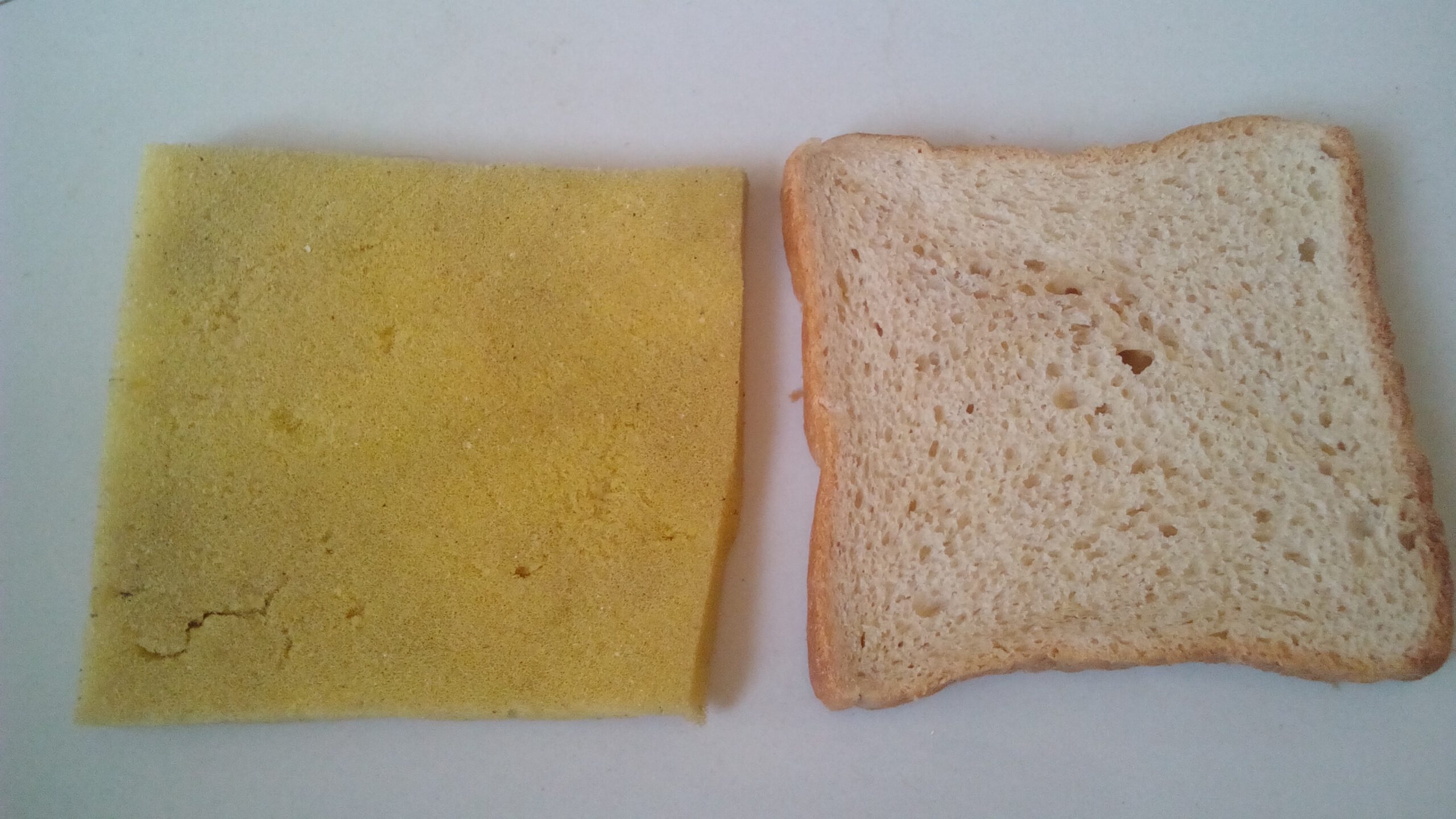
That was when a light bulb lit in my head. I have a small piece of sponge shaped remarkably like a slice of bread – now that I thought of it – and he was doing what I did to messes – cleaned them up with the sponge! Awwwww….
All the frustration vanished in a puddle of mommy melt.
I gave him the sponge and he “cleaned” away to his heart’s content. And no, I really can’t blame him for the misunderstanding because you see…
Who can blame Nisarga for thinking the slice of bread can be used for cleaning, if his mom regularly uses the sponge on the left for exactly that?
I don’t go around telling people to vaccinate or not vaccinate. I frankly don’t know if his disability is because of the vaccination or because of something else that coincided with it, but I didn’t notice. And because I cannot be certain of that, I don’t go around telling people not to vaccinate.
On the other side, the complete certainty with which pro-vaccine people push their agenda as the whole and complete truth turns science into a religious faith.
What science knows is constantly updating. Things thought safe earlier are considered unsafe later (cigarettes). Things thought to be dangerous earlier turn out to be safe (coconut oil or butter for cooking). These are just two random examples out of many. The idea that science knows all there is to know about vaccines is unscientific. At the same time, calling vaccines unsafe because anecdotal data ‘could’ be proved right one day is equally unscientific. All we have to go with is research data that currently declares vaccines safe.
This data is not without its problems. Here are some problems I faced in ruling out vaccines as the cause of my son’s disability.
There are no reports of your son’s symptom associated with this vaccine
This is a common reply I got. Yet, of dozens of doctors we have seen over the years, not a single one took details to report the onset of symptoms my son faced. Leads me to wonder how many cases are not reported because “there are no reports”. A sort of self perpetuating religious belief.
There is no way to rule out vaccine damage
I have asked doctors over and over if there is a test or something that can rule out vaccine damage. There isn’t. So one wonders where the certainty comes from.
If it merely comes from research, but the system ignores parents actually reporting symptoms developing in their child, how reliable is the research as the final word?
Quality of vaccine
In India, where spurious drugs are hardly big news, and even the government has been known to purchase from suppliers with known problems in quality standards, the research findings are rendered irrelevant, because the actual vaccines administered can still be extremely problematic. Even properly stored vaccines can develop problems in a country where remoteness and lack of adequate standards can result in sub-standard storage or contamination. Therefore the claim of “completely safe” is not just absurd, it is potentially dangerous.
Lack of information that isn’t pushing agendas
There is an abundance of information on the claimed safety of vaccines and claimed risks of vaccines, but there is very little information that isn’t trying to promote a conclusion. It leaves parents uncertain about making an informed choice.
My view
I have my suspicions about the medical industry as a whole and have seen too much to believe that it puts the health of people first. At the same time, I don’t have the knowledge or resources to research vaccines independently to make a decision I can trust. I am certain that some vaccines do work and do save lives and protect against illnesses far more dangerous than the risks.
If I were to have another child, rather than avoiding vaccines completely or embracing them completely, I would select key ones to give based on incidence of the disease in our region, danger of the illness protected against to the life and long term health of the child, and frequency of reported harm from informal anecdotal routes. I would additionally recommend parents, particularly in India to go the extra mile to ensure that other potential causes of risk can be reasonably ruled out – purchasing from reliable sources, checking expiry and so on.
It would be nice if the doctors honestly recorded parents reporting reactions in children after vaccination instead of saying “oh, it doesn’t happen, there is no record of it (because we don’t record it?)”. It would give parents real information to make an informed choice instead of having to rely on cherry picked information from either side.
It also needs to be remembered that the chances of the vaccine preventing the disease it claims to prevent are higher than the chances of adverse effects, so vaccines for life threatening diseases prevalent in my region may not be such a bad gamble – even if vaccines came with some risk. Would I give my child a small pox vaccine if reports of cases in my region emerged? Damn right I would. Would I vaccinate him for Hepatitis B – which is primarily contacted through bodily fluids, infected syringes or sex – if I was clear at time of birth? Probably not. Particularly since the protection would not last till the time they came of age to be sexually active. If my child were sick and needing surgical procedures or frequent injections or be in places where infection from urine of other people, etc would be a risk? I would consider it. Would I give it to him if I were in some rural place with dubious medical services (like most of India)? Probably not. Would I vaccinate my child for chicken pox or the flu? Nope. Cervical cancer vaccine? Never. Heard too much pushing from profiteers (who conveniently fail to mention is doesn’t protect against all types) and too many stories of harm. How many people get cervical cancer anyway in a currently barely vaccinated population?
My last thoughts on this subject is that there is a need to stop reducing science to blind faith and provide the masses with enough data of reports and research and questions raised that they can make an informed choice. There is also a need to stop treating vaccines like one monolith as though they are all equally effective and equally necessary and that people owe it to humanity to inject each and every one into their child.
There is a need to elevate thinking on this issue and that cannot happen if supposedly educated people create “scientific” superstitions around vaccines.
Disclaimer: I do think that nothing beats actual practical hands on learning and if you are learning to help a loved one, nothing beats getting them to a real Feldenkrais Method practitioner – it will be years before your competence will match – if at all. However, if you are not able to get to one – for whatever reason, I have discovered that it is possible to be persistent and learn by simply seeking knowledge.
Here is a list of resources that helped me. These resources are strictly from a “learning to help someone move better” perspective. Nisarga has Cerebral Palsy so it is possible that I focused on some more than others based on what I found useful. For the purposes of this list, I am including any practice that evolved from the Ferldenkrais method (such as the Anat Baniel Method) as well, since the fundamental method and attitude toward improvement is the same.
Awareness Through Movement lessons
Awareness Through Movement lessons or ATMS as they are called helped me understand my body tremendously and this helped me try and understand. What we use with children is “Functional Integration”. However, the approach toward helping the body learn movement is the same and our understanding helps us offer possibilities to the child better.
The fundamentals of the Feldenkrais Method Approach
Before you begin doing anything with your child (or adult) understand some things that are fundamental to the method. To do this, it is best to pay attention when you are reading, watching videos and so on for the principles that the practitioners think are important. These three things I had to keep coming back to more than others – they could be different for you:
No pain, no forced movement
I cannot stress this enough. With all the best intentions, I have found myself using too much force almost continuously in the beginning (and by beginning I mean first couple o YEARS) though fortunately not to the point of pain. Be warned that it is difficult to let go of the conditioning that makes us put in more effort when something doesn’t work. In such situations what invariably worked was LESS effort. Making the movement smaller, or slower or changing the position from it which was done. As in – no head on collissions with failure. Back off, go around try something similar with another limb and if you find yourself obsessing, just let go and do something else. Pain is a complete NO. This is not a bleeding heart thing, anything that causes pain will be avoided by the child. Your session will be wasted even in the unlikely situation you manage to break new ground.
Clarity
I found myself eager to do something. And I really mean something, anything. And that did not help. In fact it harmed. I started getting much better results when I did not touch Nisarga unnecessarily and move him without any idea of what I was trying to do. The importance of seeing the movement you are trying to do clearly in terms of how the body moves cannot be overstated. The more random clutter you add to what you are doing, the more you will end up confusing yourself and even if something works, you will have no idea how it worked.
Building a library of movements
Creating detailed mental views of how a movement plays out on the whole body in your mind – for example “what happens to my lower back if look up?” and not just “how does my head move to look up?” I don’t think this is ever complete, but if there was one thing that didn’t let me leverage one success to lead to others in a natural flow, it was this. I had to go back and study movements and see videos and do ATMS to see what possibilities existed in the new thing he had been able to do instead of spontaneously flowing to include the new abililty and working with it.
This is THE book that helped me understand how to do Functional Integration sessions. Any time I have no idea what I want to do in a session this is where I return. To pick up an idea, see how it can progress. The detailed descriptions and meticulous manner of explaining are like a window into the mind of a practitioner with extreme clarity on what and how the body moves. It isn’t a book that will absorb you or one that you can read from cover to cover in a go. More like a reference manual.
This is less a book about therapy or the Feldenkrais Method or as she calls it the Anat Baniel Method alone and more a book that states the fundamentals of the learning process itself in a way that you remember. Specific chapters devoted to how you can expand your child’s potential by focusing specific things are very handy. I found this more of a book of how to create a learning environment rather than specific learning events alone. It is very useful if you want to create an environment that is constantly facilitative to learning. It will involve evolving how you are with your child. The most important thing I got from this book were the importance of taking things slow, reducing effort and providing variations. While the book is written for parents of children with disabilities, it is one that will help absolutely anyone.
This book is actually a case study of the treatment of a woman who suffered a stroke and regressed severely with regard to functioning. This book is a must read because it is an insight into how holistic a view Moshe Feldenkrais took when working on a subject. The methods adopted in many cases are completely different from how we tend to visualize a Feldenkrais Method lesson. From psychology to practical efficiency and from devising methods to address specific things to completely geting into the skin of the subject to communicate in a manner that is most in tune. This is a must read because it is an extreme broadening of what we imagine we can try in order to create insight. In many ways this book was what brought it home for me how the movements while appearing to be the core of the method are merely a tool to communicate with the mind and the whole method is basically a way to get the mind to understand the body’s reality and understand what new ability will need. After reading this book, I found myself for the first time planning sessions that get Nisarga to participate in them as a thinking partner as opposed to someone I was trying to bring change to. He resonated with them better and they were more useful to him.
I have not read this book but I will be, very soon. I did not know this was published till searching for links to publish for this post. The reason I can recommend this without hesitation is that this is the same Paul Doron Doroftei who will also appear in the video references – he has Cerebral Palsy and grew to adulthood requiring a wheelchair till he was set free by Moshe Feldenkrais and his magic touch. Today he specializes in helping children thrive in spite of Cerebral Palsy. He is a practitioner who knows first hand exactly what it is like to live with Cerebral Palsy. I have absolutely no doubt that any book he writes on Cerebral Palsy will be extremely insightful and relevant to parents hoping to help their children. Highly recommended to anyone seeking to learn to work with Cerebral Palsy. Needless to say I will be reading this as soon as I get my hands on it.
Beyond this, there are many many books available. Many of which are beyond my budget and thus I haven’t got around to reading them. The experiential nature of the method practically guarantees that a book by any experienced practitioner will contain distilled learnings from their own learning journey and practice. Here are books on the Feldenkrais Method available on Amazon. If there are books you found useful not mentioned, feel free to add them in the comments.
Feldenkrais Method Videos on Youtube
Youtube has many videos uploaded by practitioners of the Feldenkrais Method and parents of children in some cases. I have found many of them really useful to learn the Feldenkrais Method, because merely reading alone does not convey the quality of the movements. Also seeing the sessions unfold often brings insight into how movements are all interlinked.
This section is going to be very big. At the moment I am trying to organize the videos that helped me the most. Till then, these are the youtube users that often have videos that have resulted in learning for me. I will try to upload a more detailed list of specific videos soon.
This list does not even attempt to begin to be complete. What I have in mind is a list of specific videos to watch and for what – a handy reference for when you need to understand something specific. It takes considerable time to watch the videos, keep track of links, write descriptions and so on, but it is close to completion and I hope to publish it within a day or two.
This list has been a long time coming, and it is nowhere near complete and will be updated and improved with descriptions and more as I am able. I am publishing it in its incomplete form on the insistence of several parents who would like to begin exploring the resources immediately and discover new ones as I add them. I understand that with your child’s well being at stake, whether the post is completed is not as important as whether what is already there helps you. So do mark this page and keep checking on it on and off for additions.
So, a light hearted update to make up for all the hundreds that I forget to post 😀
Nisarga is quite fascinated by the plants growing in the balcony and the attention I give them. Additionally, he just loves windows. So trying to get into the balcony is an ongoing obsession. Once before, he’d actually managed to get in there and I barely caught him in time to rescue my plants from potential uprooting or worse. Today, I caught him well in time. Listen to that laughter when he gets caught doing something he’d been stopped from doing before!
So far, I’ve been giving Nisarga massages with the Ayurvedic oils about once a day or every alternate day. He loves them. It is about the only time he will lie still without trying to escape while awake. I see some improvements in his strength. He’s been pulling himself up with some weight on his legs for the past few days (note – this isn’t even remotely close to standing, but with locked knees, he can put weight on his legs for a while).
He has also started babbling more and trying new sounds. A few days ago he went “aayiga” another time “yega” – without much predictability, but it is new. He’s also made “na-na” and “de-de” sounds which is new.
No idea how much of this is because of the oils and how much is because of the other changes, but whatever it is, I’m continuing the oil massages because he loves them along with everything else (cod liver oil, occasional spirulina, ashwagandha, honey, no/low gluten, more greens, etc).
Whatever the cause and extent of the changes, he’s in a growth spurt, and I’m going to help him make the most of it.